

Rust - The Great Destroyer
Rust has been called many things—"the great destroyer," "the pervasive menace," and "the evil." It's a hidden, entropic enemy that challenges the very foundation of civilization. This creeping corrosion destroys cars, fells bridges, sinks ships, and can even spark house fires, as seen when it nearly brought down the Statue of Liberty's iconic torch.
Redox Reaction
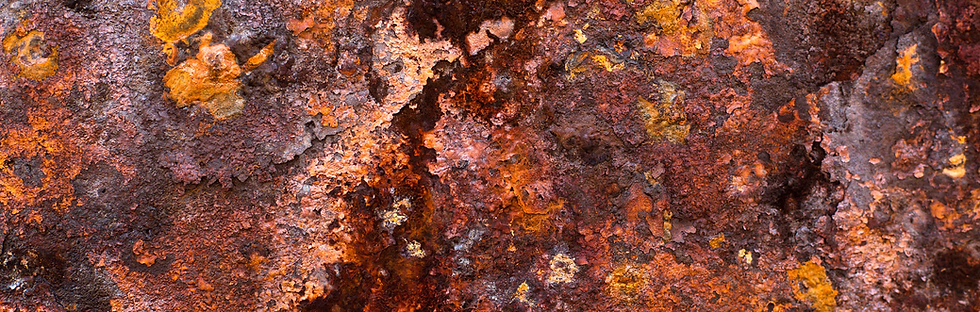
Rust is the result of a redox reaction, a fundamental electrochemical process. The term "redox" is a mash-up of reduction and oxidation. Oxidation is the loss of electrons, while reduction is the gain of electrons. In the case of rust, iron atoms in the presence of water and oxygen lose electrons (oxidation) and bond with the oxygen atoms. This creates iron oxide, a new molecule that is brittle, flaky, and reddish-brown. The reaction is self-perpetuating as the new rust layer is porous, allowing more water and oxygen to reach the underlying iron and continue the destructive cycle.
Importantly Stainless is not immune to rust. It is highly rust resitant but not rust proof. It's why it's called Stainless not Stain-never.
For any knife enthusiast, rust is a particularly potent enemy. It not only corrodes away the blade and creates weak spots, but it can also impart an unpleasant metallic flavor to food, tainting the very dishes a good knife is meant to help create.
Why Iron Loves to Rust
Why does this happen so easily? The truth is, iron can't help but oxidize. In its pure elemental form, iron is an unstable, energetic state. The oxidized form of iron, or rust, is thermodynamically its favored state. This is the state that iron "wants" to be in, a low-energy configuration that is far more stable. Essentially, a pristine iron blade is fighting an uphill battle against nature, always seeking to return to its original, oxidized form from the earth.

Patina: Rust's Benign Cousin
Fortunately, not all oxidation is destructive. While rust is the flaky and corrosive iron oxide, there's another form of oxidation that is beneficial and beautiful: patina. A patina is a different, more stable form of iron oxide, typically a bluish-gray or brownish-black layer of magnetite (Fe3O4). This patina develops slowly over time through a neutral reaction on the blade's surface, particularly when using the knife for acidic foods like onions or lemons.
Unlike rust, a patina is a dense, non-porous layer that protects the steel underneath, significantly halting the formation of destructive red rust. The reaction is neutral, meaning it doesn't impart any flavor to your food.
A patina tells the story of the knife's use and care, adding character and a unique aesthetic. Embracing a patina on your knives is a smart way to protect them while celebrating their history. The key to avoiding rust and encouraging a healthy patina is simple: clean your knives immediately after use and keep them dry.


Comments